



“Can blogs actually generate sales?” If you have the same question on your mind, I don't know what you expect, but the answer is “No.”
I mean, you can consistently publish blogs every single day for six months and still not make a single sale. At most, your website's organic traffic climbs up a bit, and that doesn't even guarantee sales.
If you've experienced this, you would likely agree with me that blogs, in and of themselves, don't generate sales.
On the other hand, if you ask me, “Why are my blogs not generating sales?” I can look through your last 5 blogs and tell you exactly what is wrong. Because the truth is, generating sales with blogs goes beyond writing and publishing new content every day. In fact, consistency alone doesn't bring sales.
Brands that truly understand how this strategy works are generating massive sales simply by publishing blog posts that answer their potential customers' questions. For instance, Zai, a payment fintech brand, generated over $150,000 in sales-qualified leads through product-led blogs.
So, the issue is never blogs; the issue is the strategy behind them. And in most cases, it comes down to the same fintech content marketing mistakes brands keep repeating without realizing it. That's why, in this guide, I'll show you why your blogs aren't generating sales and what you can do to fix it.
5 Reasons Why Your Blogs Are Not Generating Sales and How to Fix Them
Your blogs aren't generating sales because you only write about topics you like, not the ones your audience needs; they are not SEO-optimized, you don't distribute them, you rely solely on your website's authority, and your content doesn't answer readers' questions.
1. You Write Topics That You Like, Not The Ones Your Audience Needs
If you choose your blog topics based on inspiration, what you feel like writing, or what you “think” your audience will like, you are already doing it the wrong way. And that's why you end up investing time and resources in creating content that attracts the wrong audience or no one at all.
Why? You ask.
Here's the reality with online searchers: people don't browse the internet for fun. Instead, they browse when they have a specific question or problem that needs an answer or a solution. If your blogs are not tailored to answer questions or solve problems that will lead to sales, your potential customers are never going to find them whenever they are ready to make a purchase.
Therefore, if you've been posting product-specific content such as how your product works, what your product does, or broad topics that do not attract ready-to-buy customers, you need to change your strategy.
How to Identify Topics That Attract Ready-to-Buy Customers
Before you brainstorm blog topics, identify your customers' pain points. What problems are they facing that your product can solve? In what specific scenario would your product help them? These are the questions that should shape your blog topics.
For example, if you offer a cross-border payment solution, you could write an article titled “How to pay international suppliers in the US,” since that's a specific scenario where your product can help. Use these questions to brainstorm topic ideas.
2. Your Blogs Are Not SEO-optimized
If you have been consistently publishing blogs and have never thought about adding the right keywords, optimizing your images and meta descriptions, or structuring your content with the right headers, you're already burying your content in the depths of the internet before it even goes live. When people can't find your content in the top results, it doesn't exist. Content that doesn't exist cannot generate sales.
That's the simple math between blogs and sales.
How to optimize your blogs
1. You don’t have to be an SEO guru before you create SEO-optimized blogs; here are a few important strategies to implement:
Identify keywords your potential customers are likely to enter in a Google search query when they are looking for an answer to a question you want to address in your blog.
For example, if you are writing an article on “how to pay international suppliers,” possible keywords your potential customer might use are “pay international suppliers” or “send money to international suppliers.” You can also use tools like Semrush to identify more keywords relevant to your fintech SEO content writing goals.
2. Naturally integrate these keywords throughout your content, including the introduction, headings and subheadings, body content, conclusion, and meta description.
3. Optimize your images with keywords. Instead of saving images with random names like “img0027,” use descriptive names like “pay-international-suppliers.png.” You should also optimize your image alt text to improve your chances of ranking in Google Images.
If this feels overwhelming to handle on your own, Edgerank offers fintech SEO and blog content strategy services that cover all of this, from keyword research to full content optimization, so you don't have to figure it out from scratch.
3. Your Blogs Do Not Answer Readers’ Questions
This may sound trivial, but it is very easy to overlook the fact that the reason you are creating a blog in the first place is to answer readers' questions and nudge them to take a specific action. If your answer is generic or doesn't address what your readers actually need, they won't hesitate to abandon it halfway because there are countless other answers online.
The implication is that they will never see your CTA or the action you want them to take. And when that happens, sales won't come in.
So ask yourself: have the blogs I have been publishing genuinely helped my readers, or did I just write them for the sake of it?
If your answer is the latter, you know where the issue is.
4. Your Blogs Only Sit On Your Site
If you only publish blogs on your site and wait for people to find them, you're already cutting yourself short.
Sometimes, the people who need to read your content won't find it through search alone. And remember the rule: if they can't find it, it doesn't exist. If it doesn't exist, it cannot generate sales.
Therefore, it's your job to distribute your blogs across the channels your potential customers use so they can see them, read them, and take whatever action you want them to take.
How to Distribute Your Blogs Across Various Channels
Step 1: Identify your content's target audience, meaning who you are writing for. For example, freelancers, contractors, or business owners.
Step 2: Identify where they hang out. For example, freelancers spend time on X (Twitter) and LinkedIn, while business owners are more active on LinkedIn or Reddit.
Step 3: Restructure the blog as a native post on these platforms. For example, a carousel on LinkedIn, a native Reddit post on the same subject, or a short thread on X.
Even if you have a solid fintech content marketing strategy and you're doing everything else right, relying solely on your website to host your content is a slow game, especially if your site is relatively new and has little to no domain authority.
Here's how it works: search engines use backlinks and brand mentions from authoritative websites as a trust signal. The more reputable sites that reference your content, the more likely search engines are to rank your pages higher. Without that external validation, your blogs are competing at a disadvantage from the start.
So, while you continue publishing on your own site, you also need to build authority from the outside.
How to Fix This
Guest post on authoritative fintech websites. Platforms like Finextra, The Fintech Times, and Forbes Fintech have large, relevant audiences and strong domain authority. Getting featured on them does two things: it sends referral traffic directly to your site, and it signals to search engines that your brand is credible.
You can also publish original data and research. Fintech brands that release reports on topics like cross-border payment trends, savings behaviors, or transaction habits naturally attract backlinks from journalists, analysts, and other publications that cite the data.
This is also an area where working with a specialized team pays off. Edgerank, a fintech SEO agency, helps brands build this kind of external authority through strategic guest posting and link-building, so your content gets the backing it needs to rank and generate leads consistently.
How to Create Blogs That Generate Leads for Your Fintech Business
Now that you know what's holding your blogs back, here is a straightforward process to create fintech content marketing that actually moves people toward a purchase.
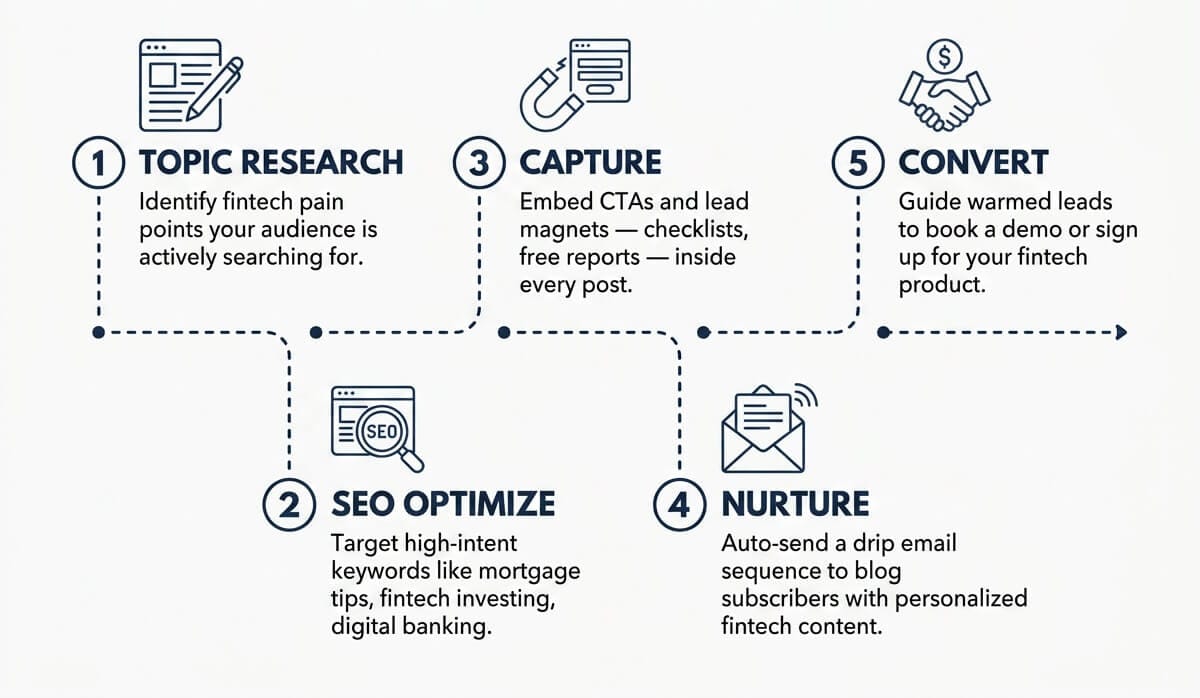
1. Start With The Customer, Not The Product
Before you open a new Google Doc, ask yourself: what is my potential customer searching for right now, and what do they need to believe before they are ready to buy? Every blog topic should trace back to a specific pain point and a specific moment in the buyer's journey.
2. Target High-Intent Keywords
Use tools like Semrush or Ahrefs to identify keywords that signal buying intent. These are phrases like “best platform to receive international payments,” “how to send money from the US to Nigeria without fees,” or “payment link for freelancers.”
These are the searches people make when they are close to a decision, not just browsing. This is the foundation of generating leads for your fintech business through organic search.
3. Write for Conversion, Not Just Information
A blog that generates sales has a clear structure: acknowledge the reader's problem, introduce your product as the solution, show them exactly how it works, and give them a clear next step. That next step could be signing up, requesting a demo, or reading a related article that takes them further down the funnel.
Avoid vague, surface-level content. The more specific and useful your blog is, the longer readers stay, and the more likely they are to trust you enough to take action.
4. End With a Clear CTA
Every blog should have one clear call to action. Not three. Not a generic “learn more.” Tell your reader exactly what to do next and why it benefits them. For example: “Create your free account and receive your first international payment today.”
5. Track What's Working
Use Google Search Console to monitor which blogs are generating impressions and clicks. Use Google Analytics to see which ones are driving conversions. Over time, you'll notice patterns in the topics, formats, and keywords that consistently generate leads for your fintech business. Double down on those.
If you'd rather skip the trial and error and work with a team that already knows what works, Edgerank builds and manages end-to-end fintech content marketing strategies for brands that want real results, not just organic traffic. You can book a free strategy call to see how they can help.
Conclusion
Blogs can generate sales. But only when the right strategy is behind them.
If your content has been sitting on your site without driving results, the five reasons covered in this guide are the most likely culprits. You are either writing about the wrong topics, skipping SEO optimization, leaving your blogs to collect dust on your site, failing to genuinely answer your readers' questions, or depending entirely on your website authority to do all the heavy lifting.
The good news is that every single one of these is fixable.
Start by going back to the basics: identify what your potential customers are actually searching for, create content that speaks directly to their problems, optimize it properly, and distribute it across the channels they already use. Do that consistently, and your blogs will stop being a vanity exercise and start becoming a real lead generation engine for your fintech business.
And if you would rather hand this off to a team that already knows how to make it work, Edgerank specializes in fintech content marketing and SEO strategy for brands that want organic growth to translate into actual revenue. Book a free strategy call and let them show you exactly what that looks like for your brand.
Frequently Asked Questions About Fintech Content Marketing
Why Are My Blogs Getting Traffic But Not Generating Sales?
Traffic without sales usually means one of two things: you are attracting the wrong audience, or your content is not moving readers toward a decision. If your blogs rank for broad, informational keywords, you will attract readers who are just browsing, not buyers. The fix is to shift your focus to high-intent topics that attract people who are already close to making a decision and to ensure every blog ends with a clear next step that nudges them toward your product.
How Long Does It Take for Fintech SEO Content Writing to Generate Results?
Fintech SEO content writing typically takes three to six months before you start seeing consistent organic traffic and leads. That timeline exists because search engines need time to crawl, index, and rank new content. The upside is that once your content ranks, it continues generating leads without additional spend. A well-written blog targeting the right keyword can drive qualified traffic for years.
What Types of Blogs Generate The Most Leads for Fintech Businesses?
The blogs that generate the most leads for fintech businesses are the ones that target buyers who are close to making a decision. These include comparison pages, product alternatives, how-to guides that feature your product as the solution, and listicles that include your brand alongside competitors. These formats work because they attract readers who are actively searching for a solution, not just browsing for information.
What Do Agencies Offering Fintech SEO And Blog Content Strategy Actually Do?
Agencies offering fintech SEO and blog content strategy, like Edgerank, typically handle the full process: identifying the right keywords, creating content that targets your potential customers at every stage of their journey, optimizing that content for search engines, and distributing it across relevant channels. A good agency doesn't just write blogs; it builds a content system aligned with your growth goals so that every piece of content has a clear job to do.
Can Small Fintech Startups Generate Leads With Content Without a Large Budget?
Yes, and content is one of the most practical ways for fintech brands to generate leads. Paid ads require ongoing spend and stop the moment you pause them. Content, on the other hand, builds over time. A single well-optimized blog can generate leads for months or years after it goes live. The key is to focus on quality over quantity, target keywords your potential customers are already searching for, and distribute your content across the channels they already use. Starting with three to five high-intent blogs per month is more effective than publishing ten generic ones weekly. And if you need support getting started, Edgerank works with fintech startups at various stages to build content strategies that align with their goals and budgets


