



Search Engine Optimization (SEO) remains one of the most cost-effective ways to grow your fintech brand and, by extension, your revenue.
Even with the rising pandemic of zero-click searches in the AI era and various hot takes claiming SEO is dead, brands with strong SEO performance are still consistently driving leads across various channels.
For instance, Zai, a B2B payment orchestration company, grew its total leads by 350%, generating over $150,000 in sales-qualified leads (SQLs) through product-led, SEO-optimized blogs (according to Mint Studios).
If you have decided to add SEO to your marketing strategy for your fintech brand, you are on the right track.
However, random SEO strategies and tactics won’t cut it. Otherwise, you’d only amass vanity metrics like organic traffic or views that don't directly translate to revenue.
You need effective SEO strategies to build your brand authority, earn people and search engine trust, and drive conversions that translate to demo requests, funded accounts, transaction processing, and more, depending on what conversions mean for your brand.
And that is exactly what this article is all about: to provide effective and actionable SEO strategies you can implement to grow your fintech brand.
Top 6 Fintech SEO Strategies to Grow Revenue in 2026
The top 6 SEO strategies for fintech companies in 2026 include setting clear, achievable goals, auditing your site's technical SEO, identifying keywords that align with your goals, creating high-quality content, leveraging community SEO, and getting brand mentions from authoritative sites.
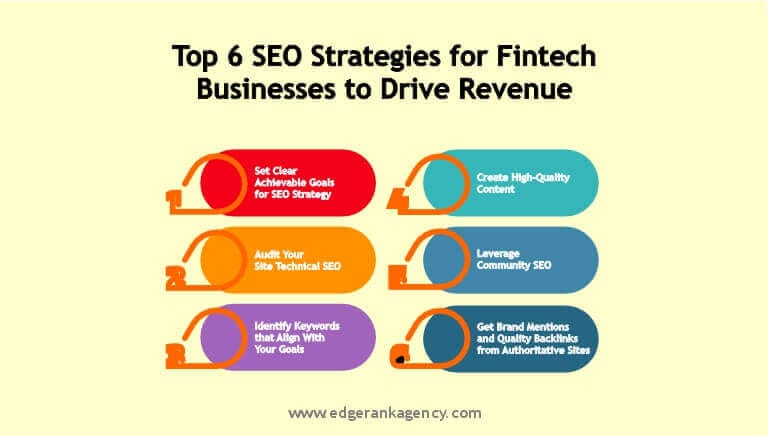
1. Set Clear Achievable Goals for SEO Strategy
Many people jump straight to implementing SEO strategies without even having a clear goal of what they want to achieve. The truth is, even the most effective SEO strategies in the world won’t work if you don’t have a clear goal of what you want to get from the strategy.
So, before you implement any SEO, brainstorm with your team members (or alone) to identify SMART goals you want to achieve.
Your goal could be to onboard 150 new users and have them complete at least one transaction within 3 months, or increase your organic traffic by 50% within 2 months if your goal is to drive brand awareness.
The goal ultimately depends on what growth means to your brand.
Deliverables
Create a new doc file and write a SMART goal you want to achieve with SEO. SMART simply means it must be Specific, Measurable, Actionable, Realistic, and Timebound.
2. Audit Your Site Technical SEO
Building a house on a faulty foundation is similar to implementing SEO strategies on a site with faulty technical SEO, it will eventually collapse.
Even if you have the best product, create high-quality content, and optimize your site with high-intent keywords, people will leave your site if it takes 3 seconds to load. Search engines, on the other hand, won’t crawl your site properly if you have any indexing-related issues.
This is even more important for fintech products, where users often go through multiple steps like sign-up, KYC verification, and transactions. Any delay or friction in these areas can affect both your rankings and conversions.
Therefore, before implementing any SEO strategy, audit your site's technical SEO to check for hidden, critical issues that may be limiting your performance.
Common issues include slow loading speed (especially on landing and product pages), broken links and redirect chains, indexing and crawlability issues, duplicate content across similar pages (e.g., country or currency pages), and poor mobile experience
Identify and fix these issues before moving on to other SEO strategies.
Deliverables
Use tools such as Google Search Console and Screaming Frog to identify any issues on your site.
You can also outsource your site's technical SEO audit and fixes to Edgerank Agency, a professional technical SEO agency.
3. Identify Keywords that Align With Your Goals
One reason most brands think SEO doesn’t bring sales or revenue is that they are ranking for the wrong keywords.
Imagine your fintech brand offers payment links, and you are ranking for random keywords like “kyc verification” or broad ones like “online payments”: it won’t drive any real results even if you rank first on Google. Why? Because it doesn’t align with your brand goals of making sales.
To achieve the goals you have set earlier (in the first strategy), conduct keyword research to identify what your audience is searching for on the internet.
For instance:
- If your goal is to drive sign-ups or transactions, target high-intent keywords like “receive international payments,” “send money from the US to Nigeria,” or “best payment link for freelancers.”
- If your goal is awareness, you can target broader educational keywords—but ensure they are still relevant to your product and funnel users toward conversion.
Also, prioritize keywords based on where users are in their journey:
- Problem-aware: “How to receive payments from abroad.”
- Solution-aware: “best platforms to receive international payments.”
- Product-aware: “[your brand] vs competitors”
This helps you create content that meets users at every stage and gradually moves them toward taking action.
Deliverables
Use tools like Semrush or Ahrefs to identify keywords that align with your goals, and group them based on intent and user journey before creating content.
4. Create High-Quality Content
This is where you get to use all the keywords you identified in the previous step. Create high-quality content and naturally integrate these keywords to make your brand visible when users search for answers on Google or on AI-powered chats such as ChatGPT or Claude.
Here are proven content formats to double down on
i. Your Brand vs. Competitor: This content format targets users who are actively comparing options and are close to making a decision. Use this to clearly highlight your unique features, pricing advantages, speed, fees, or ease of use
The goal is to position your product as the better choice while still being honest and transparent.
ii. Landing Pages: Create individual landing pages for each of the products you offer and optimize them with specific keywords that clearly explain what the product does, who it is for, and how to get started.
For instance, you can have a separate landing page for payment links, virtual USD cards, and USD accounts if you offer these products.
III. Listicles Highlighting Top Alternatives: Create content that compares different tools or platforms in your niche, including your product. Instead of overly promoting your brand, focus on giving genuine comparisons, highlighting use cases, and helping users make informed decisions. This builds trust and increases the chances of conversion.
iv. How-to Guides: Create content that clearly explains how users can solve specific problems using your product. For example: how to receive international payments as a freelancer or how to create and share payment links
These guides attract users with clear intent and position your product as the solution.
5. Leverage Community SEO
In a trust-sensitive industry like Fintech, people and even search engines often rely on human reviews and recommendations over marketing content. Even AI-powered chats like ChatGPT and Perplexity heavily pull insights from online communities like Reddit and LinkedIn, according to SemRush.
You can use this to your advantage by creating an active online presence across various online communities.
Here is a simple community SEO strategy
- Participate in discussions that relate to the problems your product solves. For instance, if your product helps users receive international payments, engage in conversations around payment issues, delays, or fees on platforms like Reddit and Quora.
- Provide value first before mentioning your product. Avoid spamming links. Instead, give clear, helpful answers and only introduce your product where it naturally fits as a solution.
- Repurpose your existing content into native posts. Turn your blog posts into simplified threads, answers, or short-form posts that fit each platform.
- Encourage real customer reviews. Ask satisfied users to share their honest experiences on platforms like Reddit, LinkedIn, Google Play Store, or the App Store. These reviews can influence both potential users and how your brand is perceived online.
- Stay consistent. Community SEO is not a one-time effort. The more consistently you show up with valuable contributions, the more visibility and trust your brand builds over time. In many cases, your brand might be discovered through a Reddit thread or LinkedIn post before users ever visit your website.
6. Get Brand Mentions and Quality Backlinks from Authoritative Sites
Quality backlinks and brand mentions from authoritative sites can significantly improve your brand authority and increase your visibility.
Backlinks remain one of the key trust signals search engines use to evaluate your website. In fintech, this is even more important because trust plays a major role in whether users decide to use your product or not.
Getting featured on reputable platforms not only improves your rankings but also exposes your brand to a wider, relevant audience.
- Guest post quality content on authoritative sites: Target platforms your audience already trusts, such as American Banker, Finovate, Forbes Fintech, and TechCrunch Fintech. These sites carry strong domain authority and reach the exact decision-makers you want in front of your brand.
- Create link-worthy content: Publish content that naturally attracts backlinks, such as original research, surveys, reports, and data-driven insights
- For example, fintech brands can publish reports on spending habits, savings trends, or cross-border payment challenges
- Get featured in industry publications: Share insights, data, or expert opinions with journalists and media platforms. This can help you earn mentions from high-authority sites.
Frequently Asked Questions About SEO Strategies for Fintech Brands
What Fintech Topics Attract Backlinks in 2026?
The best content that attracts backlinks in 2026 includes original research papers and surveys that solve critical problems or answer people’s questions in the fintech industry. For example, creating a savings report or survey on personal finance if you offer savings and investment services.
What Tools Are Helpful for Fintech Marketing Campaigns?
The top helpful tools for fintech marketing campaigns include Google Analytics to create data-driven marketing strategies based on your website performance, Hotjar to visualize how users engage with your site, and Semrush to get reports on SEO, PPC, and content.
What is the Best Fintech SEO Agency for Startups?
The best fintech SEO agency for startups is Edgerank. This agency has a team of marketing professionals who understand the fintech industry and create and implement data-driven strategies that align with your growth goals, so every dollar you spend counts.
Conclusion
Implementing the right SEO strategies can make a real difference for your fintech brand.
Remember: Zai grew its leads by 350% and generated over $150,000 in SQLs through SEO alone. That kind of result doesn’t come from random tactics: it comes from building a solid foundation, targeting the right keywords, creating content that speaks to your audience at every stage of their journey, and earning trust through community and authoritative backlinks.
If you’re ready to start, go back to strategy one: define your SMART goal, audit your site, and build from there. And if you’d rather focus on building your product while experts handle the growth side, you can outsource your fintech SEO to Edgerank Agency, a team that understands the industry and knows how to turn organic traffic into real revenue.
